For Board Eligible OB/GYNs

Your data. Your keys. HIPAA Safe Harbor de-identification — physician-verified, forensically audited.

PDI Med was designed from the start with one constraint: physicians must be able to trust it completely. Here is exactly how that trust is built, where your data lives, what we can and cannot access, and why using PDI Med is fully HIPAA compliant.

AWS HIPAA-eligible infrastructure AES-256-GCM encryption Physician-controlled keys Patent-pending architecture
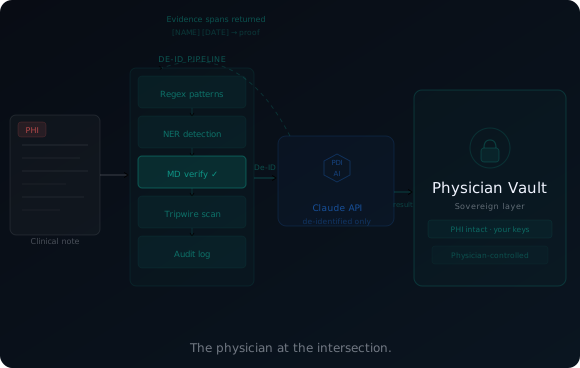
Clinical note through 5-layer de-identification pipeline to Claude API and Physician Vault
01 — Where Your Data Lives

AWS HIPAA-eligible infrastructure. AES-256-GCM. Only you hold the key.

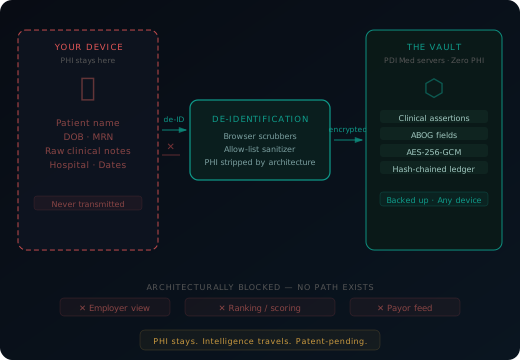
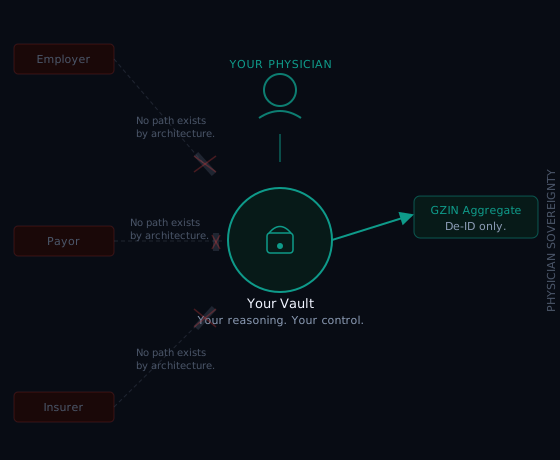
Your case records — full clinical detail, patient identity intact — are encrypted with AES-256-GCM before they leave your device. The encryption key is derived from your physician credentials and never transmitted to PDI Med. Our servers receive and store a ciphertext blob. We cannot read it. We cannot decrypt it. We cannot hand it to anyone.

That vault is stored on AWS infrastructure in a HIPAA-eligible environment — the same cloud environment used by major health systems, insurance companies, and federal health agencies. This is not a startup server in a co-location facility. It is enterprise-grade, audited, and contractually governed by AWS's HIPAA Business Associate Agreement with PDI Med.

Your data is also portable. You can export your complete vault at any time — every case, every note, every field — in a format you control. If you leave PDI Med, you leave with everything you put in. Nothing is held hostage.

One exception worth naming: the de-identified intelligence that flows into the GZIN — aggregate signals, population-level patterns, de-identified clinical assertions only — belongs to PDI Med. That's the trade. Your PHI stays encrypted and physician-controlled. The anonymized knowledge it generates funds the platform that protects it.

AWS HIPAA-eligible AES-256-GCM encryption Physician-controlled keys Full data portability
Vault architecture
02 — HIPAA Compliance

Compliant by architecture. Not by checkbox.

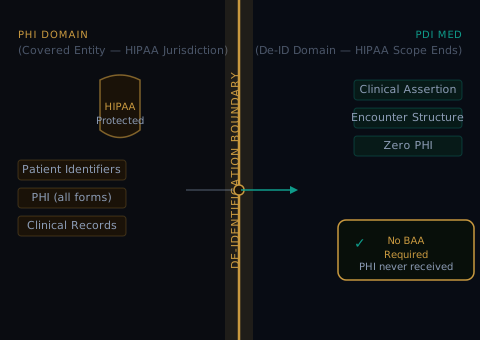
HIPAA compliance for a clinical intelligence platform comes down to two questions: where does PHI go, and who can access it? PDI Med's answers are architectural — baked into how data moves, not just what the privacy policy says.

PHI stays in your encrypted vault

Your full clinical records — patient name, date of birth, MRN, diagnosis, note content — are encrypted under your key and stored as ciphertext. PDI Med systems cannot access the plaintext. No PDI Med employee can read your cases.

De-identification happens on your device — not on our servers

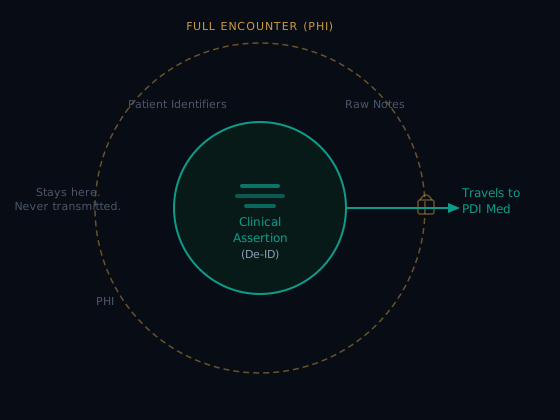
When you choose to contribute a case to the GZIN collective intelligence layer, de-identification runs locally through five layers before anything leaves your device. The GZIN layer receives de-identified clinical assertions only — diagnoses, procedures, vitals, ABOG categories. No identifiers of any kind.

What the AI receives — in plain language

Your note goes through five layers of de-identification before anything reaches PDI Med's AI. What the AI receives is clinical language only — diagnosis, procedure, vitals, clinical reasoning — the same information you'd share in a grand rounds presentation. Patient name, date of birth, and medical record number are removed before transmission. You see and approve the de-identified output before it leaves your device. Evidence spans in every AI response prove exactly what was sent — the output is its own forensic record.

The de-identified intelligence is ours — and that's intentional

The de-identified clinical patterns, ABOG category distributions, and procedure classifications you contribute become part of PDI Med's collective knowledge base. We curate, protect, and use this intelligence to improve the guidance every physician on the platform receives. No individual physician's identity is traceable in it. The intelligence travels. The identity does not.

PDI Med operates as a Business Associate

PDI Med signs a Business Associate Agreement (BAA) with institutional partners. As a physician, your use of PDI Med for ABOG case log collection is consistent with HIPAA's framework for clinical tools used by covered entities. You retain your own HIPAA obligations as a treating physician — PDI Med doesn't change them.

ABOG's de-identification standard is already built in

ABOG requires that your submitted case list use patient initials only — that's the HIPAA Safe Harbor de-identification standard (§164.514(b)). PDI Med generates your ABOG export in that format automatically. The file you export for ABOG is already de-identified. You don't have to do that work separately.

We are happy to provide technical documentation of our security architecture to any physician or institutional legal team requesting it. Contact us directly.
HIPAA boundary diagram
03 — PDI Med vs. Spreadsheets

Every problem with Excel for case logs. Solved by design.

Spreadsheets are what physicians use when no better option exists. They are not HIPAA-compliant when they contain PHI and sit on an unencrypted personal laptop. They have no validation, no flags, no backup, no version history, and no export that matches ABOG's format. The file you build over 12 months is one hard drive failure away from gone.

Data loss risk Eliminated.

Your full vault — every case, every field, every note — is encrypted and backed up automatically. When your laptop dies, your case log doesn't die with it.

The June chart review Eliminated.

21 intelligence flags fire at commit. Missing uterine weight, wrong category, absent GA — caught the day you log the case, when you still know where to find the answers.

PHI compliance on a personal laptop Solved.

An Excel file with patient names, dates, and diagnoses on an unencrypted personal laptop is a HIPAA exposure. PDI Med encrypts before storage. The vault is compliant. The spreadsheet wasn't.

The ABOG submission rebuild Eliminated.

Spreadsheets don't produce ABOG-format exports. PDI Med does. De-identified, board-formatted, all required fields included or flagged. Generated in 10 seconds. Ready to paste into ABOG's portal.

Spreadsheet vs PDI Med
04 — Works With Any EMR

No IT project. No institutional approval. Start today.

PDI Med does not connect to your EMR. There is no integration to configure, no IT department to engage, no institutional sign-off required. You paste a clinical note — H&P, operative note, office visit, delivery note, whatever you wrote for that patient — and the parser does the extraction.

This means PDI Med works with Epic, Cerner, Athena, eClinicalWorks, or any other system your institution uses. If you can copy text from a note, you can use PDI Med. There is no exception list. There is no waiting for your health system's IT roadmap.

Now
Copy-paste workflow — any EMR, any format

Copy your clinical note. Paste into PDI Med. Parser extracts ABOG fields in ~20 seconds. Works with any EMR that can display a note as text.

Roadmap
Native EMR integration — reducing cognitive burden further

We are actively working with EMR partners on contextual launch integrations that will reduce the copy-paste step entirely. You don't have to wait for this — the current workflow works now — but it's coming.

Your right to copy your own notes is federally protected. Under the 21st Century Cures Act (Pub. L. No. 114-255) and the ONC Information Blocking Rule (45 CFR Part 171, effective April 2021), no hospital IT department, EMR vendor, or health system can legally prevent you from accessing your own clinical documentation for professional purposes. You authored these notes. Board certification is a direct professional obligation. Copy-paste is not a workaround — it is a federally protected access method. Download physician independence letter →
Legacy physician access is coming. We're starting with new attendings because that's where the pain is sharpest. If you're an established attending — stay close. It's coming.
Any EMR workflow
In Development

The AI Board Examiner is coming. See the full architecture →

05 — AI Board Examiner

Practice defending your actual cases. Free. Unlimited.

Once your case list is built, you can practice defending it.

Your cases. A simulated ABOG oral board examiner. "Tell me about this patient." You present. "What else?" You add more. "What if she deteriorated?" "What if you're at a rural hospital?" "What does ACOG say about that?"

The examiner doesn't affirm you. It doesn't say "great answer." It asks "What else?" until you run out. That's the board format. That's what you're preparing for.

At the end: a structured debrief. Strengths. Gaps. The ACOG guideline you need to review. One board tactic specific to your session.

Board prep companies charge $300–500 for generic question banks. PDI Med gives you an examiner that knows your actual cases. Included. No extra charge.

Try the Board Examiner →
Board examiner interface
06 — Frequently Asked Questions

Architecture and compliance — answered directly.

Is using PDI Med HIPAA compliant?

Yes. Your vault contains PHI encrypted under your physician-controlled key — PDI Med cannot read it. Case log data passes through five layers of de-identification and physician preview before any transmission. The GZIN layer receives only de-identified clinical assertions — diagnoses, procedures, vitals — never patient identity. PDI Med operates as a Business Associate and signs BAAs with institutional partners. The architecture was designed specifically to meet HIPAA Safe Harbor requirements for clinical data tools.

Do I need hospital or institutional approval to use PDI Med?

PDI Med doesn't connect to your EMR, your hospital network, or any institutional system. You copy a clinical note and paste it into PDI Med. There is no IT integration, no network access, and no institutional approval required. If your institution has policies about external clinical tools, consult your compliance office — but PDI Med doesn't require any institutional touchpoint to function.

Can PDI Med see my patient data?

No. Your vault is encrypted with a key derived from your credentials. We receive and store a ciphertext blob — we cannot decrypt it, read it, or provide it to anyone. The only data PDI Med systems can access is de-identified clinical intelligence you explicitly choose to contribute to the GZIN layer, and even that goes through de-identification on your device first.

What happens to my data if I stop using PDI Med?

You can export your complete vault at any time — every case, every note, every field. Your data is yours. If you leave, you leave with everything. We do not hold data hostage or charge for export. Your case logs belong to you.

Is the ABOG export actually in the right format?

Yes. De-identified per HIPAA §164.514 (Safe Harbor — patient initials only). Formatted to ABOG case list field requirements. All required fields included or flagged as missing. The file you generate is the file you submit. No reformatting required.

What if I already started collecting in Excel?

Start using PDI Med from here forward. Log going-forward cases through the parser. You don't lose your prior work — you stop losing what comes next. Most attendings who switch mid-year wish they'd started on day one, but switching in month three is still significantly better than switching in month twelve.

What's the difference between the vault and the GZIN?

The vault is your encrypted personal clinical record — full PHI intact, accessible only to you. The GZIN is the collective intelligence layer — de-identified clinical assertions only, contributed with explicit per-case physician consent after five-layer de-identification and your verification. These are two separate, architecturally distinct systems. Participating in one does not require participating in the other.

For Board Certified OB/GYNs

The problem we solved first was acute. What we're building for you goes further.

PDI Med was built first for the physician facing their most acute problem: building a case log from scratch, under time pressure, with no tool designed to help them. That problem is specific to board eligibility. But the intelligence we are building is not.

"The physician you are at year 10 is built on the decisions you made in year 1. PDI Med is building the infrastructure to make that relationship visible."

For board certified OB/GYNs, PDI Med's roadmap extends beyond case log compliance into career-span clinical intelligence — the kind of platform that has never existed for established attendings. Here is what we are building toward.

Career Intelligence
Your full clinical decade — case volume, surgical complexity trend, outcomes patterns — surfaced as usable intelligence, not locked inside disconnected EMR systems.
Protocol Drift Detection
Where your clinical practice has diverged from evolving ACOG evidence — surfaced privately, without judgment, before it becomes a problem.
MOC Integration
Continuing certification tracking built around what you actually do clinically — not generic question banks disconnected from your practice.
Mentorship Intelligence
Seeing where the physicians you trained end up — and how your teaching shaped their practice patterns — as the cohort data matures.

None of this is available today. We are telling you now because the physicians who join as clinical faculty in the next 12 months will shape how this platform is designed. You won't be inheriting it. You'll be building it with us.

Clinical Faculty · The Profile

Not everyone is the right fit.
You might be.

The physician who wants to be an ABOG examiner —
but whose position makes that impossible.
Program directors, academic faculty, and attendings who actively teach residents already think in the examiner frame. They know how to push without being punitive. They understand that the goal is not to stump a candidate — it's to find the edge of their knowledge and help them recognize it. If you've wanted to examine and can't, or if you already do this informally with your own residents, you're exactly who we're building this for.
You find teaching energizing, not obligatory. The physicians who do the best work in this role light up when a candidate gives a wrong answer and they get to guide them back. That quality is not trainable. Either it's there or it isn't.
You know how to apply pressure constructively. Oral boards are stressful by design. A good examiner replicates that environment without making it punitive. The stress is the point. The cruelty is not.
You're still practicing clinical medicine. The credibility of this role depends on being current. A physician who is actively managing patients brings something to these sessions that a retired examiner cannot.
You understand that this is a side engagement, not a job. Flexible scheduling, 1099 consulting, your calendar. This works well for physicians who want meaningful supplemental income without the overhead of a second clinical role.
The Role

What the sessions actually look like.

The platform does the analytical work before you arrive. Your 30 minutes is spent doing what you already do well — applying clinical judgment under pressure.

You receive a brief before every session
PDI Med generates a complete clinical brief — the physician's case list compliance status, their highest-risk cases by examiner vulnerability, and a transcript of their AI board examiner session showing exactly where their verbal reasoning broke down. You arrive knowing where to push. Preparation time: approximately 10 minutes.
30-minute live Zoom session — you run it like an examiner
One physician. Their specific cases. You open with the highest-risk case identified in the brief, push on the follow-up question, move through the priority cases, and close with strategic counsel. You don't follow a script — you follow the physician's reasoning.
No report writing — the platform handles it
After the session, PDI Med generates the post-session brief automatically from the recording transcript. The physician receives it within an hour. You do not write a report. Your value is what happens in the room — not what you type afterward.
Educational consulting — standard employment carve-out
This engagement is structured as medical education consultation — the same category as expert witness work, CME speaking, and ABOG examining panel service. Employed physicians routinely hold these engagements alongside hospital employment. We recommend reviewing your specific contract and will discuss this during onboarding.
Faculty Standards

Quality is the product. We protect it seriously.

Every faculty member is interviewed before onboarding. Every session is rated — by the physician, and by the faculty member. The feedback is bidirectional and it informs everything.

Onboarding interview
A conversation, not a form
Every faculty candidate speaks directly with PDI Med's founder before onboarding. We're evaluating genuine interest in teaching — not just availability. If it's the right fit, we both know it by the end.
After every session
Ratings go both directions
The physician rates the faculty member on session quality, clarity, and the pressure applied. The faculty member rates the accuracy of the platform brief. Both signals inform how the platform improves and how faculty progress through tiers.
Faculty tiers
Your track record becomes your credential
Faculty progress through tiers as sessions accumulate and ratings hold. Tier advancement is not automatic — it reflects sustained quality. Higher tiers carry higher booking rates from candidates booking sessions directly.
The standard
We remove faculty who aren't right for this
A faculty member who consistently receives low ratings or uses sessions punitively rather than constructively will be offboarded. This is not punitive — it's a product standard. These physicians are preparing for one of medicine's most consequential examinations.
Founding FacultyFirst cohort · ≥5 sessions
Senior Faculty25+ sessions · 4.5+ rating
Lead Faculty50+ sessions · 4.8+ rating
From Interest to First Session

Five steps. Honest about all of them.

01
Express interest below
Short form. Takes two minutes. We review within one week.
02
Interview with PDI Med founder
30-minute conversation covering your clinical background, teaching experience, and how the platform works. This is a two-way conversation — you should be evaluating us as much as we're evaluating you.
03
Platform onboarding
90-minute walkthrough of the faculty dashboard, brief format, session guidelines, and examiner probe library. Consulting agreement and 1099 setup. Founding faculty onboarding bonus after completing your first 5 sessions.
04
First sessions — observed and calibrated
Your first 5 sessions are reviewed for quality calibration. Feedback is direct and specific. After the first cohort, you set your own calendar and manage your own schedule.
05
Public faculty profile
After completing 5 sessions with strong ratings, you appear in the PDI Med faculty directory — visible to candidates booking sessions. Your specialty focus, practice setting, and faculty tier are listed.
Compensation

Competitive. Transparent. Paid per session.

No retainer. No minimum hours. Paid per completed session.

Standard session $150 per 30-minute session
Brief review before the session (~10 min). 30-minute live session. No report writing afterward.
Annualized · 3 sessions/week $23K estimated, standard rate
Flexible enough to increase or decrease month by month based on your clinical schedule.

Payments via 1099 consulting agreement. Direct deposit within 7 days of session completion. Founding faculty receive a $500 onboarding bonus after completing their first 5 sessions.

Requirements

The baseline.

The requirements are straightforward. The harder question — whether this is something you actually want to do — is what the interview is for.

Board-certified in Obstetrics and Gynecology (ABOG)
Actively practicing clinical medicine
Minimum 3 years post-certification
Comfortable in a structured examination or teaching role
Reliable video conference access and a private space
Not currently serving as an active ABOG oral examiner
Transparency

What you'll see after onboarding.

We've described the surface here deliberately. The full picture — how the platform prepares your brief, what the AI board examiner session produces, what you'll see before every session, and how we've structured the technology so the analytical work is already done before you arrive — is shared with faculty after onboarding.

What we can say now: the prep work per session is minimal by design. We built the platform so that physicians like you spend their time doing what physicians do — not reading compliance reports or counting case log fields.

Shared post-onboarding
Full platform and faculty dashboard walkthrough
How the session brief is generated before you arrive
Examiner probe library and session structure
How post-session briefs are produced automatically
Faculty community and peer review access
Platform roadmap and how faculty shape it
Expression of Interest

Let's talk.

This is a short form, not a formal application. If it seems like a fit, we'll be in touch to schedule a conversation.

Coming July 1, 2026

Applications open July 1.

This form will open for board-certified OB/GYN physicians on July 1, 2026. Stay connected →

This is an expression of interest, not a formal application or commitment. We'll follow up by email when we can. All inquiries are confidential. Contact: dan@pdi-med.com