PDI Med · Oral Boards Prep

Stress Adaptation.
Not stress removal.

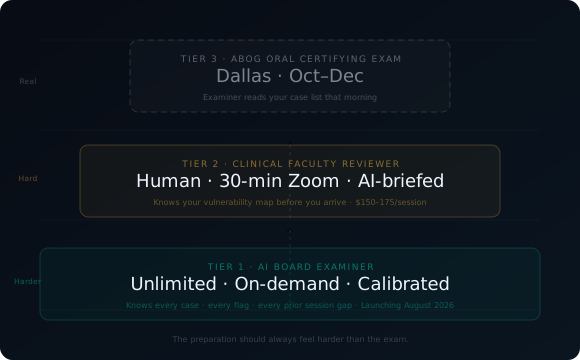
The board isn't testing what you know. It's testing whether you can defend what you know under pressure, in real time, with a stranger asking the follow-up. Three tiers. Each one harder than the last. Each one making the next survivable.

Tier 1 — Included Tier 2 — AI Examiner Tier 3 — Live Reviewer No scutwork between you and readiness
Three-tier oral board preparation — Tier 1 AI Examiner, Tier 2 Clinical Faculty Reviewer, Tier 3 ABOG Certifying Exam
01 — The Architecture

Every tier has a job. They build on each other.

Most board prep starts at the wrong end: hypothetical cases, question banks, things with no connection to the actual case list you submitted. PDI Med starts with your real cases — the ones the examiner has already read before you walk in.

Each tier eliminates one layer of friction and increases the pressure that remains. By Tier 3, the only thing left is the thing that actually counts.

Tier 1
AI Case Log Intelligence
Included
  • Asynchronous — run any time, as many times as you want
  • Zero pressure — private, no clock, no one watching
  • Scans your committed cases against examiner probe patterns
  • Surfaces HIGH / MEDIUM / LOW vulnerability by case
  • Generates a gap report that feeds directly into Tier 2
PRESSURE
Tier 2
AI Board Examiner
In Development
  • Real-time conversational simulation — asks your follow-up
  • Controlled pressure — private, repeatable, no human stakes
  • Text mode and Voice mode (Beta)
  • Opens on your highest-vulnerability case from Tier 1
  • Does not explain or teach during session — pushes like a real examiner
  • Structured debrief generated after 4 cases or 8 exchanges
PRESSURE
Tier 3
Live Human Reviewer
Paid Consultation
  • Live Zoom — 30 minutes, a real person watching
  • Witnessed pressure — the shock of another person present
  • Reviewer receives your Tier 1 + Tier 2 outputs as a brief before the session
  • Session opens on the exact gaps Tier 2 exposed
  • AI-generated post-session brief delivered within 1 hour
PRESSURE
"We don't remove the stress of oral boards.
We build your tolerance to it."

Most preparation eliminates scutwork but leaves the physician unprepared for the actual experience. PDI Med eliminates scutwork too — compliance work, case formatting, chart archaeology. But what remains is designed to be hard. Each tier increases the pressure deliberately. By the time you sit in front of a real ABOG examiner, you've already sat in front of something like it. The shock has already happened. Safely.

02 — Tier 1: Vulnerability Map

Your case list, read the way an examiner reads it.

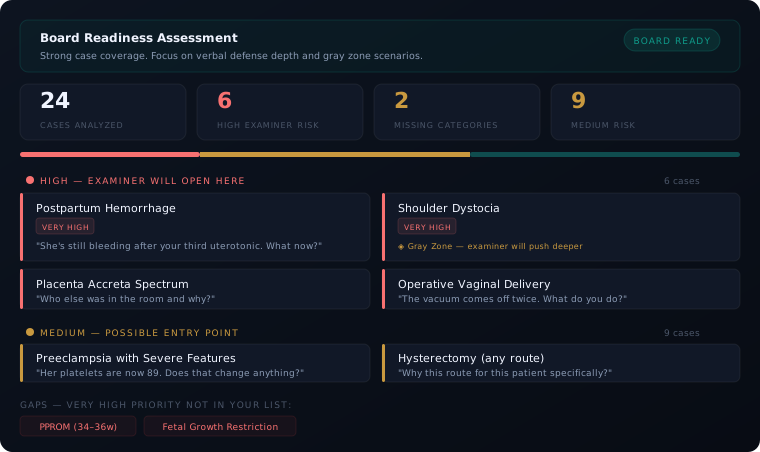
Once you've reached 50% of the minimum required cases in a section, PDI Med runs your de-identified case data through the examiner vulnerability model — the same framework that predicts which cases draw the second question.

Every case gets a risk level. Not based on whether you managed it well. Based on whether it's the kind of case examiners probe regardless of documentation quality.

HIGH — Examiner will probe

PPH, shoulder dystocia, accreta, route selection, operative delivery. These draw follow-ups regardless of how clean your documentation is. The examiner isn't reading your note to grade you on it — they're using it to find the case worth probing.

MEDIUM — Possible entry point

One probe trigger or moderate documentation gaps. May be where the examiner starts. Depends on what else is on your list.

LOW — Unlikely primary probe

Well-documented, routine category, limited examiner interest. Low risk does not mean zero risk — it means your cognitive prep time should be spent elsewhere.

The vulnerability map is the input to Tier 2. When the AI Examiner session begins, it opens on your highest-risk case — the one the real examiner is most likely to start with.
Vulnerability map — HIGH MEDIUM LOW risk buckets with examiner probe questions for each case category
03 — Tier 2: AI Board Examiner

The shock of "I don't know how to answer this out loud" happens here. Safely.

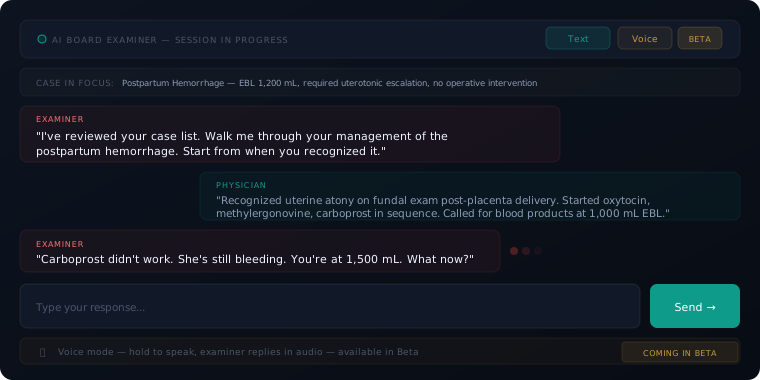
The AI is not a quiz. It is an examiner simulation. It does not explain after wrong answers. It does not praise correct ones. It pushes. It asks the second question. It says "And then?" when you trail off.

The opening line is always: "I've reviewed your case list. I want to start with [highest risk case]. Walk me through your management of this patient." From there, the examiner follows real ABOG oral board cadence — your specific cases, not hypotheticals.

The Probe Library

These are the exact follow-up lines used when a high-vulnerability case comes up. Every OB/GYN attending should be able to answer each one out loud, without hesitation, in the right order.

PPH
"She's still bleeding after your third uterotonic. What now?"
Shoulder dystocia
"You've done McRoberts and suprapubic pressure. Still stuck. Next."
Accreta
"Who else was in the room and why?"
Hysterectomy
"Why this route for this patient specifically?"
PPROM
"She's now 34 weeks, GBS positive, and has a fever. What changes?"
Preeclampsia
"Her platelets are now 89. Does that change anything?"
Operative delivery
"The vacuum comes off twice. What do you do?"
Dystocia documentation
"What did you write in the note afterward?"
Text mode launches with Tier 2. Voice mode — hold-to-speak, examiner replies in audio — follows in Beta. The session ends the same way regardless: a structured debrief you keep.
AI Examiner session interface — conversation thread with examiner follow-up, physician text input, voice mode beta toggle
04 — Tier 3: Live Human Reviewer

The reviewer already knows where you struggled before you join the call.

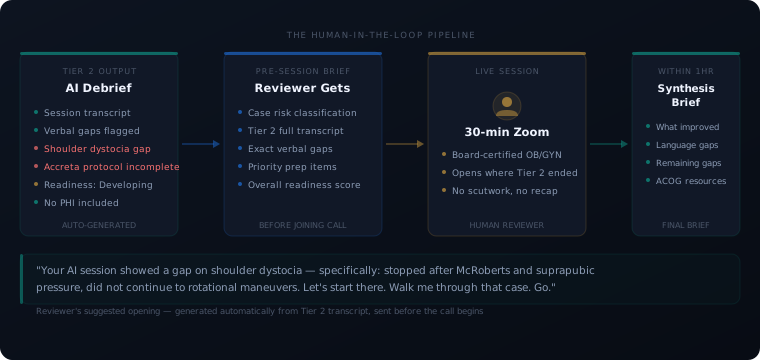
By the time you book a Tier 3 session, two things have already happened. The vulnerability map classified your cases. The AI Examiner found where your verbal defense broke down. The reviewer receives both — without any PHI — as a brief before the session begins.

They don't start from scratch. They don't spend the first 10 minutes learning your case list. The session opens exactly where Tier 2 left off.

What the reviewer receives
De-identified case risk classification. Tier 2 session transcript. Verbal gaps — the specific follow-ups that exposed incomplete defenses. Priority prep items from the AI debrief. Overall readiness assessment. All generated automatically. No PHI.
Reviewer's suggested opening
"Your AI session showed a gap on shoulder dystocia — specifically: stopped after McRoberts and suprapubic pressure, did not continue to rotational maneuvers. Let's start there. Walk me through that case. Go."

The session is 30 minutes on Zoom. When it ends, the reviewer submits their notes. PDI Med generates a post-session synthesis brief — what improved vs. the AI session, specific language improvements, remaining gaps before exam day, ACOG resources — and delivers it to you within one hour. That brief is the final deliverable before the real board.

Tier 3 human-in-the-loop pipeline — AI debrief to reviewer brief to 30-min Zoom to post-session synthesis within 1 hour
05 — The Debrief

What you walk away with after every Tier 2 session.

The AI Examiner does not explain during the session. Everything that matters is in the debrief. It's generated from the session transcript when the examination ends — typically after 4 cases or 8 exchanges.

SESSION DEBRIEF — SAMPLE OUTPUT
  • PPH uterotonic sequence — complete and in correct order
  • Hysterectomy route justification — clear rationale for laparoscopic approach
SHOULDER DYSTOCIA
Stopped after McRoberts and suprapubic pressure — did not continue to rotational maneuvers. What complete looks like: Rubin II rotational maneuver, then Woods screw, then posterior arm delivery, then Zavanelli as last resort — name them in order.
Follow-up that exposed it: "Still stuck. Next."
  • Rehearse HELPERR sequence verbally until it's automatic — especially steps 4 and 5
  • Prepare a one-sentence route justification for every GYN surgical case on your list
  • Review magnesium toxicity signs before any preeclampsia session
DEVELOPING
— 2 of 3 tiers complete

This debrief is automatically shared with your Tier 3 reviewer before the live session. They open on the verbal gaps, not the strong defenses.

Join Early Access

Tier 1 is available now. Tier 2 is in development.

Join early access to get Tier 1 case log intelligence and be first in line when the AI Board Examiner launches.

Case log collection starts immediately. Board prep features unlock at 50% of the minimum required cases per section — enough data to generate a meaningful vulnerability model. Physicians who have reached that threshold in one section but not another can request early access, with the understanding that feedback will be richer as the remaining cases are logged.

TIER 1
Vulnerability Map
Available now
TIER 2
AI Board Examiner
In development
TIER 3
Live Reviewer
Launching with Tier 2