Your OB/GYN physicians are collecting case list right now. The question is whether they're doing it safely.
PDI Med is the first ABOG case list platform built for the physician and designed with institutional compliance in mind. No IT project. No PHI on PDI Med servers. No employer dashboards — ever. Just a better tool for your physicians to do what they're already doing.
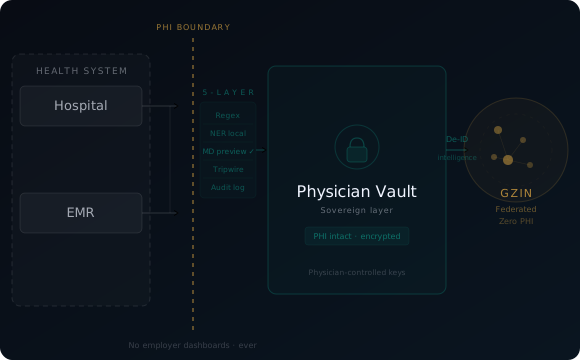
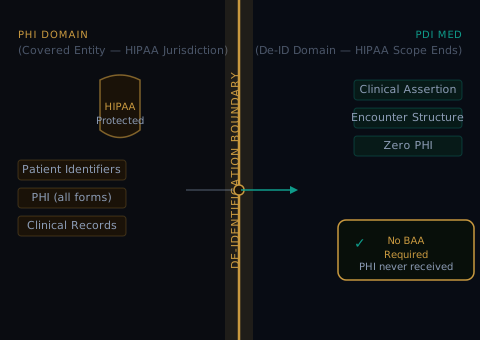
PHI never transmitted to PDI Med5-layer de-identification + physician verificationNo employer dashboards — architectural constraintBAA available on request
⚕
PDI Med is not competing with your EMR. It solves a problem your EMR
was never designed for: ABOG-format case list collection and oral board
preparation for new OB/GYN attendings in their first credentialing year.
Your physicians are not waiting for an institutional solution. They are
collecting case list right now — in Excel, on personal laptops, in
unencrypted files that represent PHI exposure your compliance team
doesn't know exists. PDI Med replaces that with an encrypted,
physician-sovereign vault. No IT roadmap required. No procurement cycle.
Available today.
01 — Why This Benefits Your Institution
Better physician tools reduce institutional risk. This one requires no IT project.
Every new OB/GYN attending at your institution has an ABOG case list obligation
that runs for 12 months. Most are managing it with a spreadsheet on a personal device —
a file containing patient names, dates of birth, diagnoses, and procedure details,
unencrypted, unaudited, and one hard drive failure away from lost.
That file is a HIPAA exposure your compliance team likely doesn't know exists,
because it isn't malicious — it's the only reasonable tool available for a
legitimate clinical need that your EMR wasn't designed for.
PDI Med replaces that spreadsheet with an encrypted physician vault. PHI stays
on the physician's infrastructure under their control, never transmitted to PDI Med
servers. The PHI risk disappears. The physician has a better tool. Your compliance
posture improves — and you didn't have to involve IT.
Risk reduction
Unencrypted PHI spreadsheets eliminated
The encrypted vault replaces the unencrypted personal spreadsheet your physicians are using today. No PHI transmitted to PDI Med. Physician-controlled keys. The risk resolves without an IT project, a procurement cycle, or a policy change.
Retention
Early-career physician satisfaction improves
Administrative burden — including case list management — is a documented driver of early-career OB/GYN burnout. Physicians who feel supported in their credentialing requirements stay longer. PDI Med compresses that burden to about 30 seconds per case — paste the note, review what was parsed, confirm the fields, commit. Done same day as the encounter, while the chart is still open.
Outcomes
Higher board pass rates for your department
The oral certifying exam is built from each physician's submitted case list. Physicians who document strategically and prepare with an examiner that knows their cases pass at higher rates. That outcome reflects on your training program and your department.
02 — How It Works for Your Physicians
No EMR integration required. Works today. PHI never crosses the boundary.
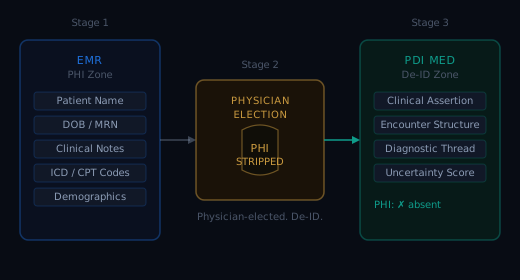
PDI Med works within your physicians' existing workflow without touching
your EMR, your network, or your IT infrastructure. A physician copies
a signed clinical note from your EMR, pastes it into PDI Med, and the
parser extracts every ABOG-required field in about 20 seconds. The full
note — PHI intact — is encrypted and stored in the physician's vault under
their own keys. PDI Med servers receive ciphertext only.
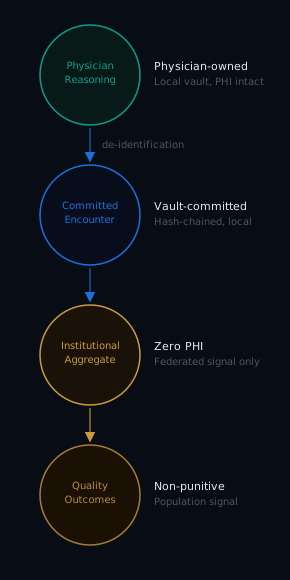
Before any clinical intelligence contributes to the collective network,
it passes through five layers of de-identification and the physician
reviews the de-identified output before approving transmission.
Nothing leaves physician control without physician verification.
Your environment
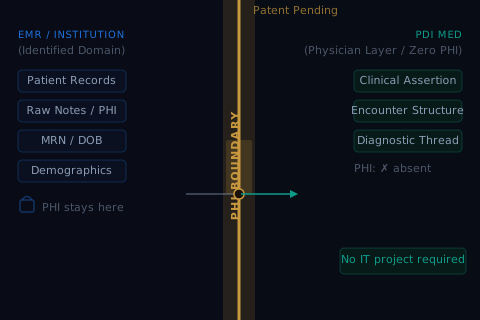
EMR, physician device, institutional network. PHI stays here. No integration required. No data export. No institutional system touchpoint.
5-layer de-ID + MD verify →
PDI Med
Physician vault (encrypted, physician-controlled keys — PHI-intact records PDI Med cannot read) + GZIN aggregate layer (de-identified clinical intelligence, zero patient identifiers, no individual rankings).
03 — Physician Sovereignty Is the Feature
Why "no employer dashboards" makes PDI Med more valuable — not less.
Physicians who believe their documentation will be used to evaluate,
rank, or surveil them document defensively — or don't document at all.
The clinical intelligence that makes PDI Med useful comes from honest,
complete documentation of what actually happened, including uncertainty
and gray-zone decisions.
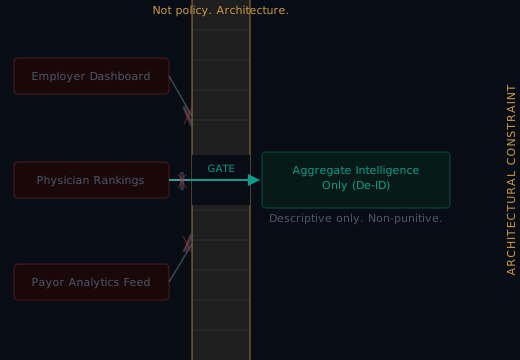
The architectural constraint that prevents employer dashboards is the same
reason physicians trust the platform enough to document honestly.
That honest documentation produces better case lists, better board preparation,
and better clinical outcomes. Physician sovereignty is not a restriction
on your institution — it is the design feature that makes everything else work.
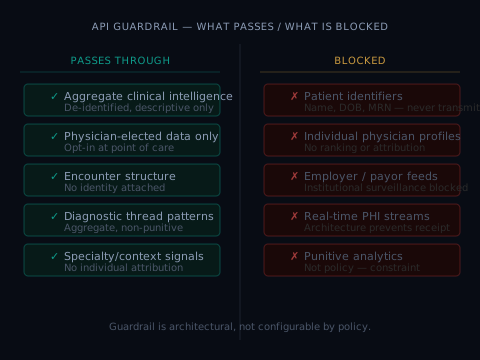
Architecturally impossible
× Employer-facing physician dashboards
× Individual physician performance rankings
× Payor or insurer data feeds
× Peer comparisons traceable to an individual
× Credentialing or malpractice data for litigation use
× PHI accessible to PDI Med staff under any circumstance
Available to institutions
→ HIPAA-compliant case list infrastructure — no IT project
→ Elimination of unencrypted physician PHI spreadsheets
→ BAA execution for your compliance records
→ Department enrollment support for new attendings
→ Technical documentation for your legal and compliance teams
→ Institutional pricing and group access for residency graduates
04 — HIPAA, Security & Compliance
Built for HIPAA from the architecture up. BAA included. No PHI on PDI Med servers.
PDI Med operates as a Business Associate under HIPAA.
The physician vault stores PHI-intact clinical records encrypted with AES-256-GCM
under physician-controlled keys — plaintext PHI is never accessible to PDI Med
systems or staff. Before any data contributes to the collective intelligence layer,
it passes through five systematic de-identification steps followed by mandatory
physician review of the de-identified output. The physician approves what leaves.
Nothing is automated past their verification.
De-identification is risk reduction, not a guarantee of perfection.
The five-layer pipeline removes structured identifiers, then runs local named-entity
recognition, then presents the output to the physician for verification, then runs
an outbound tripwire scan, then logs the transmission locally for physician audit.
We acknowledge this explicitly — it is more honest and more defensible than
a claim of absolute automated de-identification.
Business Associate Agreement
Included. PDI Med operates as a Business Associate under HIPAA. Available for execution on request. Your physicians retain their own HIPAA obligations for their vault.
PHI handling
The physician vault stores AES-256-GCM encrypted records under physician-controlled keys. PDI Med servers receive and store ciphertext only — plaintext PHI is never accessible to PDI Med infrastructure. The de-identified GZIN layer contains zero patient identifiers of any kind.
Audit trail
Every external AI processing event is logged in a local physician-side audit trail, including evidence spans — verbatim quotes of the de-identified text that was processed. The physician can verify at any time that no patient identifier appeared in what was transmitted.
Compliance documentation
Full technical security documentation available for your legal and compliance teams on request. We welcome institutional compliance reviews. Contact us to begin.
05 — Leadership FAQ
Answered for CMOs, CIOs, and legal teams.
Our physicians are using personal Excel files for case list. Is that a compliance problem?
Yes, in most cases. Personal devices with unencrypted PHI-containing files — even for legitimate clinical purposes like ABOG case list — represent HIPAA exposure. The files typically contain patient names, dates of birth, diagnoses, and procedure details. PDI Med encrypts that data under physician-controlled keys from the moment it's committed. The compliance risk resolves without a policy change or IT project.
Does PDI Med give us visibility into physician performance or board preparation?
No. PDI Med does not provide employer-facing physician views, rankings, or dashboards of any kind. This is an architectural constraint — there is no mechanism to route individual physician data to institutional administrators, because building one would violate the physician-sovereignty principle that makes physicians trust the platform enough to use it honestly. If individual physician monitoring is a requirement, PDI Med is not the right product for that purpose.
Who owns the data physicians document in PDI Med?
Physicians own their vault. Employment does not transfer ownership of a physician's clinical reasoning or their personal documentation of their own cases. The de-identified aggregate contributions to the collective intelligence network belong to the physician network as a shared clinical commons — they are not extractable or attributable to any individual physician or institution.
What does an institutional partnership actually involve?
Institutional partnerships focus on physician access and support — making PDI Med available to new OB/GYN attendings as part of their credentialing infrastructure, typically negotiated with department chiefs or CMOs. There is no data obligation on either side. Individual physician vault sovereignty is maintained regardless of the institutional arrangement. We offer group pricing, department enrollment support, and BAA execution. Contact us to discuss terms — the conversation typically starts with a 20-minute call with your department chief or CMO.
Can this be deployed without involving our IT department?
Yes. PDI Med requires no EMR integration, no network access, and no institutional system touchpoint. Physicians use it independently through a web browser on any device. There is no software to install, no firewall rules to update, and no IT approval required for physician use. An institutional BAA can be executed by your compliance team without IT involvement.
What happens if a physician leaves our institution?
The vault belongs to the physician. A departing physician takes their vault with them — the case list they built belong to their professional credentialing record, not to your institution. This is the correct outcome: the ABOG case list is the physician's personal credentialing document, comparable to a board certificate or licensure record.
Your physicians are collecting case list today. PDI Med makes that safer, smarter, and more likely to result in a passed board exam. No IT project required.
Your OB/GYN physicians are using workarounds for case list. PDI Med is what replaces those workarounds — inside your workflow or alongside it.
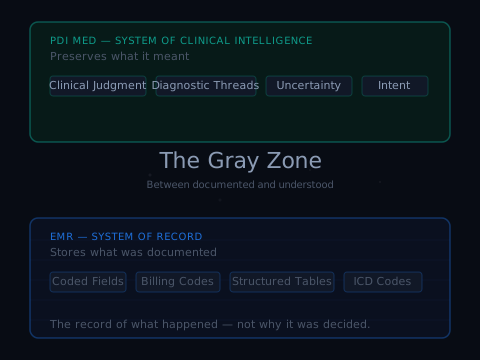
EMRs handle what they were designed for: structured documentation, order management,
billing, compliance records. What no EMR was designed for is the layer above
structured documentation — the clinical reasoning continuity, the uncertainty
tracking, the ABOG-specific case list collection that your new OB/GYN attendings
need to manage every week for twelve months.
The result: your physicians use Excel. Or they use personal Google Docs.
Or they copy-paste into a notes app. None of these are HIPAA-compliant.
None of them produce ABOG-formatted output. None of them flag when a physician
is about to miss the July 31 deadline.
PDI Med fills that gap. It can operate alongside your EMR today with zero
integration. And when you're ready, it can integrate at whatever level makes
sense for your physician workflow — from a contextual launch button to a
structured FHIR-compatible API.
What your EMR does well
→ Structured documentation and ordering
→ Billing, coding, and compliance records
→ Regulatory reporting and audit trails
→ Institutional population health views
What PDI Med adds for your physicians
→ ABOG-format case list extraction from any note
→ 21 compliance flags before the July 31 deadline
→ AI board examiner on their actual submitted cases
→ Clinical intelligence that doesn't belong in a billing record
02 — Integration That Starts Where You Are
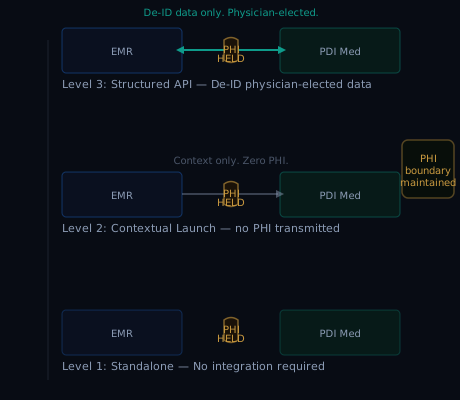
Three levels of integration. Each one adds value. None require PHI transmission. None require a major engineering commitment to start.
We designed the integration model so you can start at Level 1 today
— with no engineering work — and move to Level 3 when your roadmap
and your physicians are ready. Every level preserves physician sovereignty.
Every level is HIPAA-compliant by architecture. The value for your
OB/GYN physicians is present at all three levels.
Level 1
Standalone — available today
PDI Med operates alongside your EMR with zero integration. Physicians use it independently through a browser. No engineering work. No data flows. Full physician value. This is how most physicians start.
Level 2
Contextual launch — weeks to implement
A launch point surfaced in your physician workflow — a button, sidebar link, or context menu item. Keeps PDI Med accessible within your platform without any data crossing boundaries. Physicians stay in your environment longer.
Level 3
Structured API — 4–8 weeks
FHIR-compatible de-identified clinical context passes from your EMR to PDI Med via secure API. No PHI in transit — ever. Physician reviews and approves before any context is sent. The GZIN intelligence layer can surface within your physician UI under a partnership agreement.
At Level 3, your OB/GYN physicians have PDI Med intelligence inside your platform — without you taking on PHI liability for what PDI Med processes. That's the value proposition for your product roadmap: adding physician-native clinical intelligence to your EMR without building the intelligence infrastructure yourself.
03 — Data Architecture
What moves across the boundary. What never does. How the de-identification pipeline protects both your physicians and your platform.
The architectural separation between PHI and intelligence is the same
regardless of integration level. You don't need to implement de-identification
logic in your EMR — that happens at the physician's point of election,
in PDI Med's de-identification layer, before anything transmits.
Your EMR surfaces the workflow. PDI Med handles the intelligence extraction.
PHI never moves.
Five systematic de-identification layers run before transmission:
structured pattern removal, local named-entity recognition, mandatory
physician verification, outbound tripwire scan, and local audit log.
The physician sees the de-identified output before approving it.
Evidence spans in every AI response confirm what was processed.
Your platform inherits none of the PHI liability — and gains the
intelligence benefit.
Your EMR environment
Patient records, clinical notes, orders, PHI of any kind. Stays here. Always. Your platform carries no responsibility for what PDI Med processes — because PHI never leaves your environment.
physician election5-layer de-IDMD verify →
PDI Med
De-identified clinical assertions. Reasoning patterns. Specialty intelligence. No patient identifiers of any kind. Evidence spans confirm what was transmitted. GZIN aggregate surfaces as intelligence for your physician UI.
FHIR-compatible Level 3 APIHIPAA-eligible infrastructureNo PHI in any API payloadPhysician-approved election at every stepEvidence spans as transmission proof
04 — What We'll Never Enable Through Integration
These constraints protect your physicians, your platform, and PDI Med equally. They are architectural — not contractual promises that can be amended.
EMR vendors integrating with PDI Med inherit the same physician-sovereignty
constraints that govern PDI Med's own products. This is not a negotiating
position — it is the architectural design.
A platform that could be used to surveil physicians would be a platform
physicians don't trust, which means no honest documentation,
which means no useful intelligence, which means no value for your integration.
The constraint is what makes the value possible.
These apply regardless of integration level, contract structure, or institutional request.
Architecturally disabled via integration
× PHI passthrough to PDI Med in any API payload
× Employer-facing or administrator-facing physician views
× Individual physician ranking, scoring, or benchmarking
× Payor, insurer, or employer data feeds derived from physician data
× Automatic data extraction without physician election
× GZIN dataset export or resale by EMR partner
What integration enables for your platform
→ PDI Med accessible within your physician workflow (Level 2)
→ De-identified clinical context passing via FHIR API (Level 3)
→ GZIN specialty intelligence surfaced in your physician-facing UI
→ Aggregate OB/GYN specialty intelligence for your physician population
→ Reduced physician workarounds — physicians stay in your platform longer
→ A physician-native intelligence layer without building it yourself
05 — Technical FAQ
For CTOs, product leads, and integration teams.
Why would integrating PDI Med benefit our EMR platform?
Your OB/GYN physicians are using workarounds for case list management today — Excel, personal notes apps, standalone tools. That means they're spending time outside your platform doing something clinical. PDI Med integration brings that workflow back inside your product, adds value your platform doesn't currently provide, and keeps physicians in your workflow longer. At Level 3, you can surface GZIN specialty intelligence within your physician-facing UI — clinical intelligence that no EMR has yet offered their physician population.
What API standard does PDI Med use for Level 3 integration?
Level 3 uses a FHIR-compatible API for de-identified clinical context. No PHI appears in any API payload — vault payloads are AES-256-GCM encrypted ciphertext only. Full API documentation and security specifications are available under NDA to qualified EMR partners. Contact us to begin a technical review.
Does the de-identification have to happen in our system?
No. The de-identification pipeline runs at the physician's point of election — on their device or in the PDI Med interface — before any data transmits. Your EMR does not need to implement de-identification logic. You surface the workflow; PDI Med handles the intelligence extraction. This protects your platform from PHI liability in what PDI Med processes.
Can we use GZIN intelligence in our platform?
EMR partners can surface GZIN specialty intelligence within their physician-facing UI under a partnership agreement. The underlying GZIN dataset is not extractable, resellable, or available for non-physician-facing analytics. The GZIN is a physician-sovereign collective intelligence substrate — its value to your platform comes from surfacing it to physicians, not from repurposing it for institutional analytics.
What does the Level 3 integration timeline look like?
Level 1 (standalone, no integration): available immediately for any physician. Level 2 (contextual launch): typically 1–2 weeks engineering effort on your side. Level 3 (structured FHIR API): 4–8 weeks from signed partnership agreement to physician pilot, depending on your platform architecture. We begin with a technical architecture review, then a scoped physician pilot, then production rollout. Contact us to start the conversation.
What are the HIPAA compliance requirements for integration?
PDI Med operates as a Business Associate under HIPAA. At Level 3, a BAA between PDI Med and your organization is required before any structured data flows. Your platform carries no PHI liability for what PDI Med processes — the de-identification occurs before transmission, and no PHI appears in API payloads. Full compliance documentation is available for your legal and security review teams.
Your OB/GYN physicians need what your EMR wasn't designed to provide. We built it. Let's talk about how it fits in your platform.